
BUYER RESOURCES
Free Home Buyer Tools to help GTA home buyers get organized, compare properties,
understand the market and move forward with confidence.





STILL NOT SURE?
Frequently Asked Questions
Understanding the process to purchasing a home in the Greater Toronto Area.
Question 1: How much can I afford when buying a home?
Your affordability depends on your income, savings, debts, credit score, down payment, interest rate, and monthly carrying costs. A mortgage pre-approval is one of the best first steps because it gives you a clearer budget before you start viewing homes.
Question 2: Do I need a mortgage pre-approval before looking at properties?
Yes, it’s strongly recommended. A pre-approval helps you understand your price range, shows sellers you’re a serious buyer, and can help you move faster when the right property becomes available..
Question 3: What costs should I expect besides the purchase price?
Buyers should budget for closing costs, land transfer tax, legal fees, title insurance, home inspection fees, moving costs, property insurance, and possible adjustments for taxes, utilities, or condo fees.
Question 4: What happens after my offer is accepted?
After acceptance, you’ll typically complete any conditions, such as financing or inspection, provide your deposit, we work with your lawyer and lender, arrange insurance, complete the final walkthrough, and prepare for closing day.
TESTIMONIALS
What others are saying
"Service Above Expectations"
"We got out of our house and purchased a home in the community where we wanted to be. I know many people that haven’t had that kind of success. Thanks again for everything!"
- Annette Campagnaro

"Client Care Delivered"
"We were first-time buyers, and Danny Macedo made the whole process feel manageable, even exciting. Anytime we panicked or had questions, Danny or someone on his team got back to us fast, and they alwa ys took the time to explain our options."
- Jenny Roberts
"Trusted Guidance Given"
"Danny’s pricing guidance was spot-on, and he explained the neighborhood comps in a way that actually made sense, so we listed confidently. The best part was the negotiation, because he created momentum with multiple offers, pushed terms that protected us."
- Mike Groves
Royal LePage® Supreme Realty, Brokerage
110 Weston Road
Toronto, ON M6N 0A6
Call 416-535-8000
Text 647-931-5151


Copyright 2026. Macedo Real Estate Group, Danny Macedo, Sales Representative, Anthony Rocco Macedo, Sales Representative, Royal LePage Supreme Realty, Brokerage all rights reserved assumes no responsibility for the accuracy of any information shown. The information provided herein must only be used by consumers that have a bona fide interest in the purchase, sale or lease of real estate and may not be used for any commercial purpose or any other purpose.
Elite Broker Blogs
━━━━━━━━

Why GTA Home Prices Are Soft Even as Sales Improve
A seller-focused Toronto real estate market update from Danny Macedo and the Macedo Real Estate Group
Why are GTA home prices soft even as sales improve? If you are thinking about selling a home in Toronto or the Greater Toronto Area, that question matters more than almost any headline about the market. A small increase in sales does not automatically mean prices are rising, buyers are rushing back, or every listing will sell quickly. In today's market, sellers need to understand the difference between activity and pricing power.
The short answer is this: more homes can sell while prices remain under pressure because buyers still have choices, affordability remains tight, and confidence has not fully returned. For Toronto home sellers, that means success depends less on wishful pricing and more on strategy, presentation, timing, and local market interpretation. At the Macedo Real Estate Group, led by Danny Macedo, our role is to help sellers read the market clearly before making one of their biggest financial decisions.
GTA Real Estate Market Update: Sales Are Improving, but Prices Are Still Adjusting
According to the Toronto Regional Real Estate Board, GTA REALTORS reported 5,039 home sales in March 2026. That was a 1.7% increase compared with March 2025. At the same time, the average selling price was $1,017,796, down 6.7% year over year, while the MLS Home Price Index Composite benchmark was down 7.4% year over year.
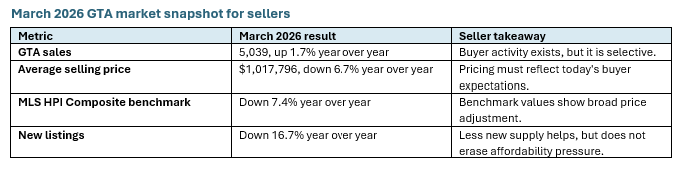
Those numbers tell an important story for sellers. The market is not frozen, but it is also not behaving like the overheated conditions many Toronto homeowners remember from previous years. Buyers are active, but they are selective. They are comparing more listings, watching interest rates, factoring in renovation costs, and negotiating harder when a property does not feel accurately priced.
TRREB also reported that March 2026 new listings were down 16.7% year over year. A drop in new listings can sometimes help sellers by reducing competition, but it does not guarantee price growth when affordability and confidence are still limiting buyer urgency.
What “Soft Prices” Really Mean for Toronto Home Sellers
Soft prices do not mean every property is losing value at the same rate. Real estate is hyper-local. A well-maintained detached home near transit may perform differently from a dated condo in a building with high monthly fees, and a renovated semi-detached home in a competitive pocket may generate stronger interest than a property needing major work.
For sellers, “soft” usually means three things:
·Buyers are less likely to overlook pricing mistakes.
·Comparable sales from even a few months ago may not reflect current buyer sentiment.
·Homes that show well and are priced correctly can still attract serious attention, while overreaching listings may sit.
This is why a current, property-specific pricing strategy is so important. A broad GTA average can provide context, but it cannot tell you exactly what your home should list for. A proper market analysis should consider your neighbourhood, property type, condition, lot size, layout, recent comparable sales, active competition, and likely buyer expectations.
Why Sales Can Rise While Prices Fall
It may seem contradictory, but it is completely possible for sales to improve while prices continue to adjust. Here are the main reasons this can happen in the Toronto real estate market.
1. Buyers are returning, but they are price sensitive
Many buyers who paused during higher-rate uncertainty are still watching the market closely. Some are returning because prices have become more negotiable, while others are motivated by life changes such as relocation, changing space needs, or the desire to move closer to work. However, returning buyers are not necessarily willing to pay last year's aspirational prices.
This creates a market where listings can receive showings and offers, but buyers may push back on price, conditions, or closing terms. Sellers who understand this dynamic can position their homes more effectively instead of chasing the market downward after several weeks with limited traction.
2. Affordability is still a major constraint
Even with lower prices in some segments, affordability remains challenging in Toronto. Mortgage payments, property taxes, insurance, maintenance costs, condo fees, and closing costs all affect what buyers can comfortably afford. A buyer may value a property highly but still need to make an offer that fits their approved budget.
That is especially relevant for sellers of homes that require upgrades. Buyers often price in the cost of renovations, repairs, and carrying costs. If your home needs work, the listing strategy should acknowledge that reality rather than assume buyers will ignore it.
3. Inventory and competition vary by neighbourhood
A city-wide market update can hide major differences between neighbourhoods and property types. One Toronto pocket may have limited detached-home supply, while another may have several similar listings competing for the same buyer. Condo inventory can behave differently from low-rise housing because buyers compare buildings, fees, amenities, layouts, and investor-owned supply.
For sellers, the key question is not simply, “What is the GTA average price?” The better question is, “What are buyers comparing my home against this week?” That is where local expertise becomes critical.
4. Economic confidence still affects big decisions
CMHC's 2026 Housing Market Outlook notes that Toronto sales activity is expected to improve in 2026 but remain below historical averages. CMHC also expects Toronto housing starts to remain low as condominium starts continue to slow, partly offset by rental construction. Buyers and sellers are operating in a market shaped by both short-term caution and longer-term supply concerns.
When confidence is uneven, buyers often take longer to make decisions. They may request more information, revisit comparable sales, include conditions, or wait for a price adjustment. Sellers who prepare for this behaviour can avoid frustration and respond strategically.
What Sellers Should Do Before Listing in Today's GTA Market
A softer-price market does not mean sellers should panic. It means the listing plan needs to be disciplined. Before you put your home on the market, focus on the controllable factors that influence buyer response.
Get a current pricing analysis, not a recycled estimate
Your home's value should be based on recent sold data, active listings, pending competition where available, and buyer behaviour in your exact area. A price opinion from six months ago may be outdated in a shifting market. The Macedo Real Estate Group reviews the numbers and the story behind the numbers so sellers understand where their home truly fits.
Prepare the home to compete
Presentation matters more when buyers have choices. That may include decluttering, minor repairs, paint touch-ups, lighting improvements, staging, professional photography, floor plans, and digital marketing. These details help buyers understand the value of the home quickly, both online and in person.
Watch the first two weeks carefully
Early market response provides useful feedback. Strong showing activity, repeat visits, and serious questions can indicate that the price and presentation are aligned. Low showing volume or consistent negative feedback may signal that buyers see better value elsewhere. A strong listing strategy includes monitoring and adjustment, not simply posting the home and hoping.
Avoid assumptions about commissions, incentives, or buyer behaviour
Compensation, incentives, inclusions, and offer terms should be discussed clearly with your real estate professional and handled in a way that complies with applicable rules. Sellers should understand their options, and any decisions should be transparent, documented, and based on their own goals. For legal, tax, accounting, or mortgage-specific questions, sellers should consult qualified professionals in those fields.
How the Macedo Real Estate Group Helps Toronto Sellers Navigate a Softer Market
Selling in Toronto today is not about guessing where the market is going. It is about interpreting the market that exists right now and positioning your home accordingly. Danny Macedo and the Macedo Real Estate Group help sellers make informed decisions with local data, practical advice, and a clear marketing plan.
That support may include:
·A neighbourhood-specific home value review.
·A pricing strategy based on recent comparable sales and active competition.
·Recommendations for staging, repairs, and presentation.
·Professional marketing designed to reach qualified buyers.
·Clear guidance through showings, feedback, offers, conditions, and closing timelines.
The goal is not to promise a specific result or pressure sellers into one approach. The goal is to help you understand your options, reduce uncertainty, and move forward with confidence.
Bottom Line: A Softer Market Still Creates Seller Opportunities
GTA home prices may be soft even as sales improve, but that does not mean sellers are powerless. It means strategy matters. Homes that are accurately priced, well-presented, and properly marketed can still stand out, especially when the seller is guided by current local data instead of outdated expectations.
If you are considering selling your home in Toronto or the Greater Toronto Area, connect with Danny Macedo and the Macedo Real Estate Group. We can help you understand what your home may be worth in today's market, what buyers are responding to, and how to create a selling plan that fits your goals.
Contact the Macedo Real Estate Group today to schedule a confidential home-selling consultation.
Source Notes
Market statistics referenced in this article are based on Toronto Regional Real Estate Board March 2026 reporting and CMHC's 2026 Housing Market Outlook. This article is for general real estate information only and is not legal, tax, accounting, mortgage, or financial advice. Sellers should consult qualified professionals for advice in those areas.