
SELLER RESOURCES
Free Home Seller Tools Practical tools to help GTA homesellers get
organized, compare properties, understand the market, and move forward with confidence.






STILL NOT SURE?
Frequently Asked Questions
Understanding the process to selling a home in the Greater Toronto Area.
Question 1: How much is my home worth?
Your home’s value depends on recent comparable sales, current market conditions, location, property condition, upgrades, layout, and buyer demand. A professional home evaluation can help determine a realistic listing price.
Question 2: When is the best time to sell my home?
The best time depends on your goals, the local market, inventory levels, interest rates, and buyer activity. In many cases, the right pricing, preparation, and marketing strategy matter just as much as timing.
Question 3: What should I do before listing my home?
Before listing, it’s helpful to declutter, clean, complete minor repairs, improve curb appeal, and consider staging. These steps can help your home show better, attract more buyers, and potentially sell for a stronger price.
Question 4: How long will it take to sell my home?
The timeline depends on your property type, location, condition, price, and market demand. A well-priced and properly marketed home can generate stronger interest and help reduce time on the market.
TESTIMONIALS
What others are saying
"Service Above Expectations"
"We got out of our house and purchased a home in the community where we wanted to be. I know many people that haven’t had that kind of success. Thanks again for everything!"
- Annette Campagnaro

"Client Care Delivered"
"We were first-time buyers, and Danny Macedo made the whole process feel manageable, even exciting. Anytime we panicked or had questions, Danny or someone on his team got back to us fast, and they alwa ys took the time to explain our options."
- Jenny Roberts
"Trusted Guidance Given"
"Danny’s pricing guidance was spot-on, and he explained the neighborhood comps in a way that actually made sense, so we listed confidently. The best part was the negotiation, because he created momentum with multiple offers, pushed terms that protected us."
- Mike Groves

Royal LePage® Supreme Realty, Brokerage
110 Weston Road
Toronto, ON M6N 0A6
Call 416-535-8000
Text 647-931-5151


Copyright 2026. Macedo Real Estate Group, Danny Macedo, Sales Representative, Anthony Rocco Macedo, Sales Representative, Royal LePage Supreme Realty, Brokerage all rights reserved assumes no responsibility for the accuracy of any information shown. The information provided herein must only be used by consumers that have a bona fide interest in the purchase, sale or lease of real estate and may not be used for any commercial purpose or any other purpose.
Elite Broker Blogs
━━━━━━━━

What the MLS® HPI Tells You That Average Price Doesn’t
By Danny Macedo and the Macedo Real Estate Group | Toronto Real Estate Market Insights
Wondering what the MLS® HPI tells you that average price doesn’t when you’re thinking about selling your Toronto home? It’s one of the most important questions a seller can ask, because headlines about the “average home price” can move sharply from month to month and still miss what’s happening to a property like yours.
In the Greater Toronto Area, market data is useful only when it’s interpreted in context. In March 2026, TRREB reported that GTA home sales were up 1.7% year over year, while the average selling price was down 6.7% to $1,017,796. At the same time, the MLS® Home Price Index Composite benchmark was down 7.4% year over year. Those numbers point in the same general direction, but they don’t measure the market in exactly the same way.
For sellers, that difference matters. A pricing strategy based only on an average price headline can create unrealistic expectations, missed buyer interest, or unnecessary price adjustments. The Macedo Real Estate Group, led by Danny Macedo in Toronto, helps sellers look beyond broad statistics and understand what the data means for their specific home, neighbourhood, and property type.
Why Average Price Can Be Misleading for Toronto Sellers
Average selling price is simple: add up the sale prices in a market, then divide by the number of homes sold. It’s easy to understand, which is why it often appears in real estate headlines. The challenge is that average price can shift quickly depending on what types of homes sold during that period.
For example, if more luxury detached homes sell in one month, the average price can rise even if most neighbourhoods are flat. If more condos and lower-priced homes sell the next month, the average price can fall even if well-presented homes in many areas are still attracting steady interest. That doesn’t mean the average price is useless; it means it needs to be handled carefully.
This is especially important in Toronto, where property types vary widely. A downtown condo, a semi-detached home in the east end, a detached house in North York, and a townhome near a transit corridor can all move differently in the same market. Sellers need a pricing conversation that goes deeper than one GTA-wide number.
What Is the MLS® Home Price Index?
The MLS® Home Price Index, often called the MLS® HPI, is designed to provide a more consistent view of home price trends. CREA describes it as a tool for gauging home price levels and trends because it tracks benchmark homes instead of simply averaging whatever sold in a given month.
A benchmark home is not necessarily one specific property. It represents a typical home for a particular property type and area, based on common attributes such as size, rooms, bathrooms, lot characteristics, parking, age, and other features. CREA’s methodology uses statistical modelling to compare similar housing attributes over time, which makes the MLS® HPI closer to an apples-to-apples measure of price movement.
For a Toronto home seller, the practical takeaway is simple: the MLS® HPI helps show whether values for comparable homes are trending up, down, or sideways, without being as easily distorted by a temporary change in the mix of homes sold.
Average Price vs. MLS® HPI: A Seller-Friendly Comparison
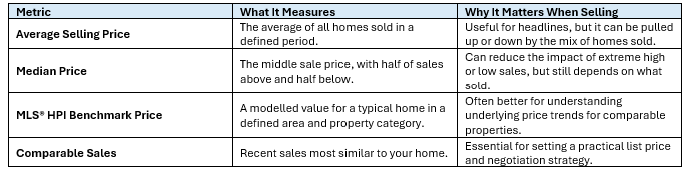
How the March 2026 GTA Data Shows the Difference
March 2026 is a useful example. TRREB reported that the average GTA selling price was down 6.7% year over year, while the MLS® HPI Composite benchmark was down 7.4%. Those figures are close, but not identical. The average price tells us what sold during the month. The HPI benchmark tells us how the value of a typical property changed over time.
That distinction helps sellers avoid two common mistakes. The first is assuming that a lower average price means every home has lost the same amount of value. The second is assuming that one strong sale nearby means the whole neighbourhood has rebounded. Neither conclusion is reliable without a deeper review of comparable sales, active competition, days on market, property condition, and buyer demand.
This is where local expertise becomes especially valuable. A market-wide report is a starting point, not a pricing plan. Danny Macedo and the Macedo Real Estate Group can interpret the MLS® HPI, neighbourhood data, and recent comparable sales together so sellers understand what their home is likely to command in the current Toronto market.
How Sellers Should Use MLS® HPI Before Listing
If you’re preparing to sell a home in Toronto, the MLS® HPI can help frame the pricing conversation. It should not replace a full home evaluation, but it can reveal whether the broader pricing trend is supporting, challenging, or neutral for your list strategy.
·Look at the relevant property type: Detached, semi-detached, townhouse, and condo trends can be very different.
·Focus on the right geography: Toronto-wide data is useful, but neighbourhood-level context is more actionable.
·Compare HPI movement with actual sold comparables: A benchmark trend should be tested against recent local sales.
·Review active listings: Your home competes against what buyers can purchase today, not only what sold last month.
·Adjust for condition and presentation: Renovations, layout, staging, maintenance, and photography can influence buyer response.
What the MLS® HPI Doesn’t Tell You
The MLS® HPI is powerful, but it doesn’t tell the entire story. It doesn’t walk through your home, assess your upgrades, evaluate your curb appeal, review your building’s reserve fund, or compare your listing photos against competing properties. It also doesn’t measure buyer emotion, which can still play a role when a home is positioned well.
It’s also not a guarantee of your final sale price. Real estate values are influenced by timing, negotiation strategy, financing conditions, inspection findings, buyer motivation, and the competitive set available at the time of listing. Sellers should use the MLS® HPI as one input within a broader pricing analysis, not as a standalone answer.
A Smarter Pricing Process for Toronto Home Sellers
A strong seller strategy usually combines three layers of analysis. First, the macro layer: GTA and Toronto market trends, including sales, new listings, average price, and the MLS® HPI. Second, the micro layer: neighbourhood-specific solds, active listings, property type, and days on market. Third, the property layer: your home’s condition, layout, upgrades, lot, exposure, parking, and buyer appeal.
When these layers are aligned, sellers can make better decisions. The goal is not simply to pick the highest possible list price. The goal is to choose a price and launch strategy that attracts qualified buyers, protects your negotiating position, and reflects the realities of today’s market.
The Macedo Real Estate Group brings that kind of disciplined, data-informed approach to Toronto sellers. Instead of relying on one headline metric, the team looks at the full picture and explains it clearly, so you can move forward with confidence.
FAQs About MLS® HPI and Average Price in Toronto
Is the MLS® HPI more accurate than average price?
The MLS® HPI is often more useful for tracking underlying price trends because it compares benchmark homes over time. Average price can still be helpful, but it can be distorted by the mix of homes sold in a particular month.
Should I price my Toronto home based on the MLS® HPI?
The MLS® HPI should be part of the pricing discussion, but not the only factor. Your list price should also consider recent comparable sales, active competition, condition, timing, and neighbourhood demand.
Why do average price and MLS® HPI sometimes move differently?
They measure different things. Average price reflects the homes that sold during the period, while the MLS® HPI tracks benchmark price movement for typical homes in specific areas and property categories.
Can the Macedo Real Estate Group help me understand my home’s current value?
Yes. Danny Macedo and the Macedo Real Estate Group can review your property, local market data, comparable sales, and current buyer activity to provide a clear selling strategy for your Toronto home.
Thinking About Selling Your Toronto Home?
If you’re considering selling, don’t rely on broad market headlines alone. The difference between average price and the MLS® HPI can affect how you interpret the market, but your home deserves a customized analysis.
Contact Danny Macedo and the Macedo Real Estate Group for a seller consultation. The team can help you understand what today’s GTA real estate data means for your property, how buyers are responding in your area, and what steps can position your home for a stronger result.
Compliance Note
This article is for general real estate information only and is not legal, tax, accounting, mortgage, or financial advice. Sellers should consult qualified professionals for advice specific to their circumstances. Real estate commissions and service terms are negotiable and should be discussed directly with the brokerage or registrant. Market statistics are historical and do not guarantee future results.
Source Notes
·Toronto Regional Real Estate Board, March 2026 Market Watch and GTA market release: https://trreb.ca/gta-homes-sales-up-and-selling-prices-down-in-march/
·Canadian Real Estate Association, MLS® Home Price Index overview and methodology: https://www.crea.ca/housing-market-stats/mls-home-price-index/
·Canadian Real Estate Association, MLS® HPI Methodology: https://www.crea.ca/files/HPI_Methodology-July-2023-rev-ENG.pdf
·Ontario Regulation 26/05 under the Trust in Real Estate Services Act, 2002: https://www.ontario.ca/laws/regulation/r05026
·Ontario Code of Ethics, O. Reg. 215/24: https://www.canlii.org/en/on/laws/regu/o-reg-215-24/latest/o-reg-215-24.html